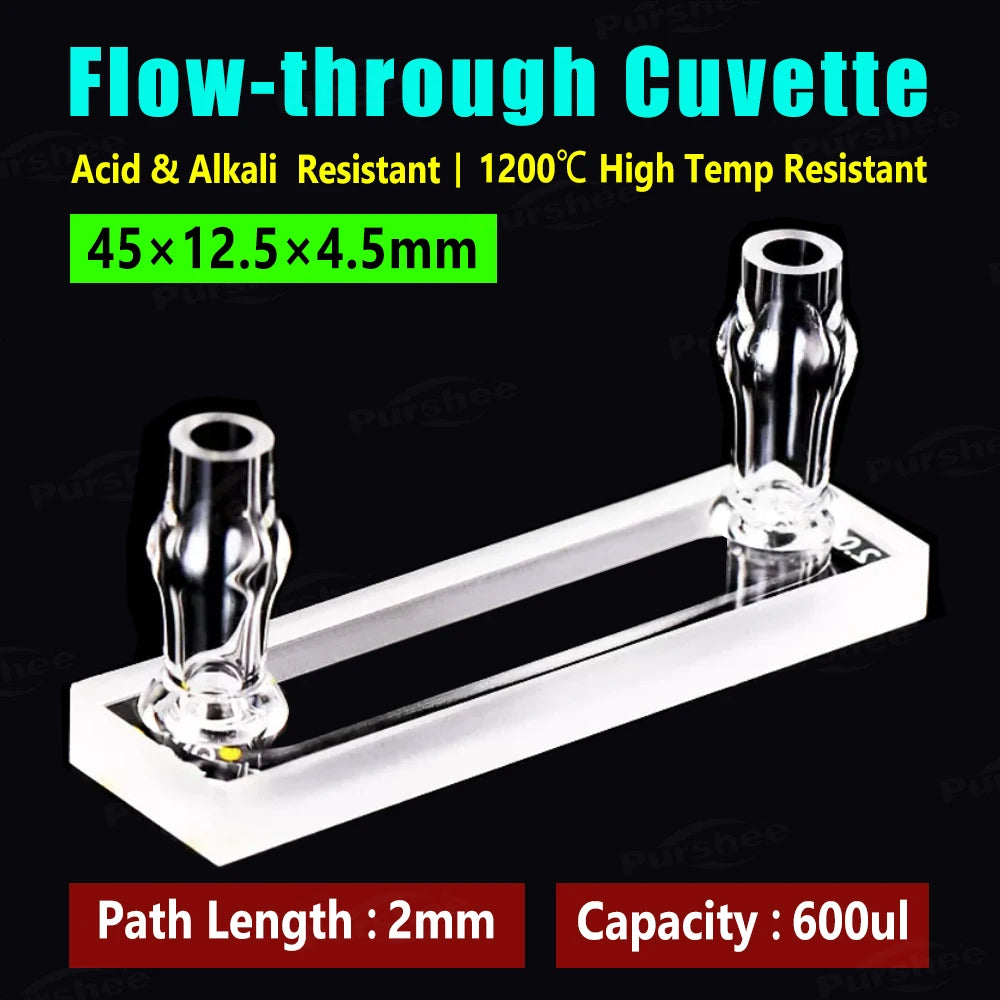
Flat, short-path flow cells made from JGS1 UV quartz with two integrated inlet/outlet tubes. The very short light paths (0.1 to 2 mm) let highly concentrated or strongly absorbing liquids be measured without dilution, and the one-piece design avoids dead volume and trapped bubbles for smooth continuous flow.
Overview
Material: JGS1 UV-grade quartz, transmittance ≥ 80% from 200 to 2500 nm.
Path lengths: 0.1, 0.2, 0.3, 0.5, 1 and 2 mm.
Volumes: 30 to 600 µL.
Outer size: about 45 × 12.5 mm plate, 2.6–5 mm thick depending on path.
Key Features
Optical contact fused: no adhesive, resists up to 1200 °C and acids/alkalis, with low error and high transmittance.
Dual-tube structure: seamless inlet and outlet for continuous flow without dead volume.
Wide compatibility: spectrophotometers, HPLC detectors and flow-injection systems.
Why use a very short path? Absorbance scales with path length. A 0.1 mm path reduces absorbance 100-fold compared with a 10 mm cell, keeping concentrated samples within the instrument's linear range.
Glue-bonded or optical contact? Glue-bonded cells are lower cost but not suited to heat, acids or alkalis. Optical-contact cells are fully fused and are the better choice for precision and aggressive chemicals.
Handling Notes
Flush with clean solvent after use and dry the channel.
Do not touch optical faces; wipe gently with lens tissue.